Showing posts with label ethics. Show all posts

Friday, June 22, 2007

Should Human Right be Taken into Consideration When Granting Preferential Trading Rights?

When it comes to international trade, there are two types of trade agreements that can have a direct influence on human rights; preferential trade agreements and trade sanctions. Whereas trade sanctions stop or severely limit the amount of trade between two countries, preferential trade agreements grant certain trade privileges to a particular country, such as very low import taxes. Although the potential effects of trade sanctions on human rights in the sanctioned country are somewhat obvious, the effects of preferential trade agreements can have many of the same negative effects as sanctions, but in a more obscure manner.

Take, for example, a situation involving three countries; A, B, and C. Country A is a wealthy developed country that has decided to give Country B, a developing country with high human rights standards, preferential trade rights in the form of no import taxes. Country C, another developing country with many known human rights violations, may also trade with Country A, but must pay the usual amount of import taxes. Both Country B and Country C export sugar to Country A.

Under these conditions, which country will assume the dominant position in Country A's sugar market? Clearly it will be Country B, since the people of Country A will be able to purchase sugar from Country B at lower prices than from Country C. How will this effect the people of Country's B and C? Those in Country B (who already have higher human rights standards than Country C) will prosper due to their sugar trade with Country A, while the people of Country C (who are already suffering from human rights violations) will suffer even more since their sugar trade with Country A will decrease as a result of Country A's preferential trade agreement with Country B.

As this scenario illustrates, when a developed countries grant preferential trading rights to developing countries who have high human rights standards over those developing countries who do not, the result is that those already suffering from domestic human rights violations suffer even more. Even though the developed country may view the preferential trade agreement as a "reward" to those developing countries who maintain high human rights standards, they may be compounding the negative situation in those low-human-rights developing countries. Essentially, these preferential trading agreements may act as partial (or complete depending on the case) sanctions against competing countries who are not granted the same preferential rights.

The World Trade Organization's policies are not very clear on this matter. "What about trade preferences made conditional upon human rights protection?...General national programs offering lower tariffs for development purposes are allowed, and what’s more, the granting state may require the beneficiary to adhere to certain standards for eligibility. Just how much a WTO Member can decide for itself whether or not to grant preferences is somewhat open – clear discrimination among similar potential recipients would probably be seen as a violation of trade obligations – but it is clear that the use of conditions in the first place is permissible" (Schefer, 2007, 8-9).

Clearly the developed international community should encourage and try to protect human rights in developing countries around the world, and that supporting human rights violating countries via open trade seems to go against this goal. In reality, however, sanctioning trade with these countries, or granting preferential trading rights to their competitors, only hurts those they are trying to help.

Therefore human rights should be taken into consideration when deciding which countries should or should not be granted preferential trading rights, but perhaps the result of such considerations will not be as expected.

Source:

Schefer, Krista Nadakavukaren. (January 2007). Economic Sanctions and Human Rights/Preferential Trade and Human Rights. NCCR Trade Regulation - Swiss National Center of Competence in Research. Reference URL: http://www.nccr-trade.org/images/stories/publications/IP4/ip4%20benefri%20t&hr.pdf

(ps - I really thought this paper was great if anyone else is interested in this topic!)


AddThis Social Bookmark Button


Technorati tags:
, , , , , , ,

Wednesday, June 13, 2007

Microloans - A Win-Win for Everyone

Microlending is the process of giving very small loans ranging from $50 to a few hundred dollars to entrepreneurs in developing countries. These relatively small loans, known as microloans, are used to promote grass-roots economic development, and have so far proven to be a very effective means of boosting the standard of living for participating borrowers, as well as the overall economies of participating countries. Although at first the idea of lending money to the poorest people in the world does not seem to make financial sense, in fact, it does.

Microloans are made typically at the prevailing commercial loan rate, and have a repayment rate between 90 to 100%, depending on the particular country (Bell et al., 346-7, 2006). Not only is this good news for entrepreneurs seeking such loans, but for lending institutions as well. With such an attractively high repayment rate, many lending institutions have come to consider microlending as very profitable venture. So far this seems to be one of those rare win-win situations for everyone.

But why do microloans have such high repayment rates, often times higher than repayment rates found in developed countries? Essentially the answer boils down to human psychology, pride, and the importance of feeling productive. In developed countries, repaying a loan is often regarded as a necessary evil, or as part of a larger financial plan. For borrowers in developing countries, however, being given the opportunity to receive a loan is in itself a matter of pride (someone has enough faith and trust in you to lend you money) so repaying the loan is of utmost importance to the borrower’s sense of self-worth.

One well known organization that uses microloans as a way to help women rebuild after war is Women for Women International. In countries like Afghanistan and Bosnia, Women for Women International organizes women into “entrepreneurial groups” that are responsible for repaying microloans after being giving the necessary entrepreneurial education and skills. In this way group members hold each other accountable for repayment and as well as provide support to each other during the process of establishing their small businesses (WomenForWomen.org). This is just one example of what used to be a traditional charity that has now embraced the idea of grass-roots economics by providing such loans.

Another important point that should be noted is many of these microloans are going to women around the world, rather than to men. According to the Microcredit Summit Campaign women are better candidates for microloans in developing countries for a variety of reasons including; being a good credit risk, investing more in their children and families which leads to the better care, education, and social development of the next generation, and raising women’s social status by allowing them to generate household income (MicrocreditSummit.org). By granting loans to women, cultural and societal development is encouraged along with economic development.

Although microlending is not a new concept, in recent years it has grown in popularity due to the ever increasing data that supports its effectiveness. Microlending helps developing nations by giving impoverished people the chance to start businesses, increase their sense of self-worth, boost their economies, and provide secure returns to investors. The idea of “charity,” or simply handing out goods and money, is not as beneficial to developing economies or to individuals as are microloans. For everyone involved, microlending is a beneficial practice that is both economically sound and socially ethical.

Sources:

Bell, Donald A. et al. (2006). International Business: The Challenge of Global Competition. Mc-Graw-Hill Irwin. New York, New York. P. 346-7.

Microcredit Summit Campaign. “About the Microcredit Summit Campaign - Why Target Women?” Reference URL: http://www.microcreditsummit.org/aboutmicrocreditsummit.htm

Women for Women International. “Microcredit Lending Programs.” Reference URL: http://www.womenforwomen.org/mlp.htm

If you would like to get involved, please visit Speak Sexy Online to find out how you can help Women for Women International with just one click!


Technorati tags:
, , , , , , , , , , , , ,

Thursday, June 7, 2007

How Investing Overseas Can Help Your Domestic Market

Investing overseas can help a firm protect its domestic market in three different ways. The first is to establish foreign operations in countries where the firm has major clients (Ball et al., 61, 2006). For example, if a U.S. firm has many customers in France, establishing subsidiaries in France to service those customers will prevent competition by similar firms in France from acquiring those customers. This strengthens the U.S. firm because they now have the opportunity to prove that they can service customers in France as well. This strategy is not very risky because the domestic firm already has customers in the foreign country. Rather than attacking the foreign market, the domestic firm is just defending itself from foreign competitors.

The second way a firm can protect its domestic market by investing overseas is to attack the foreign market in the hopes that the foreign firm will be so focused on defending its local market that it will lessen its efforts to gain customers in the domestic firm's market (Dell et al., 61, 2006). For example, if Domestic Firm A sells a similar product or service as Foreign Firm B, DFA can begin operations in FFB's country in the hopes of taking away some of FFB's customers, and causing FFB to focus on keeping its own share of its domestic market. While FFB is being attacked in its own country, DFA can work on gaining more of its own domestic market away from FFB. This technique is really one of deceptive distraction and is much riskier than the previous example because in this scenario the domestic firm must spend some resources "distracting" the foreign firm, and some resources on gaining a larger portion of its domestic market. Both of these tactics must be done at once if the plan is to succeed.

The final reason that investing overseas can strengthen a firm's domestic market has to do with costs of production. If a foreign firm can produce the same product at a lower cost than a domestic firm, and sell that product at a lower price (by exporting it) in the domestic country, then the domestic firm is at a disadvantage. One way to become more competitive is to outsource part or all of a firm's production to the "cheaper" foreign country and continue to resell the product in the domestic firm's country (Ball et al., 61, 2006). Outsourcing allows the domestic firm to utilize the lower production costs in the foreign country while remaining competitive in its domestic market. This strategy is also not very risky because it is lowering the firm's costs while defending its domestic market against foreign competition. Rather than spending more of its resources, the aim of this technique is to reduce costs and gain resources.

Although considered controversial, outsourcing continues to be a necessary part of staying competitive in today's globalized world. Two leading countries in the market for less expensive, quality labor are China and India. However, less expensive labor is not the only characteristic firms are looking for when deciding where to outsource services or production. "Deep technical and language skills, mature vendors and supportive government policies" (BusinessWeek Online, March 20, 2007) are also key factors, all of which can be found in India. For countries like the United States, where wages are high, utilizing the people and skills found in other countries and expanding to become an international firm is quickly becoming a requirement rather than a choice.

Sources:

Bell, Donald A. et al. (2006). International Business: The Challenge of Global Competition. Mc-Graw-Hill Irwin. New York, New York. P. 61.

China, India Seen Dominating Outsourcing. (March 20, 2007). BusinessWeek Online. Reference URL: http://www.businessweek.com/globalbiz/content/mar2007/
gb20070320_778394.htm?chan=search


Technorati tags:
, , , , , , , , , , , , , ,

Thursday, May 24, 2007

Blatant Lying or Smart Advertising? The MetLife Case.

Although the words "deceptive" and "advertising" are considered by many to be synonyms, there are certain industry standards that should be upheld for the good of the public. While mild exaggerations such as "the best" or "the brightest" are widely accepted, blatant lying is usually frowned upon. For example, it seems obvious that one should not advertise toothpaste as a cure for the common cold, nor life insurance as a retirement savings policy. However, the latter is exactly what MetLife did in the early 1990s to the dismay of many befuddled nurses.

But just how bad was telling nurses that a whole life insurance policy was actually a retirement savings plan? After all, whole life policies do have an investment aspect to them. In addition to the basic death benefit of all life insurance policies there is also a "cash value" with whole life policies. This cash value is made up of one's premium payments minus "administrative fees and a profit margin plus the cost of death protection" (Orman, 70, 2004). What's left after all these deductions and fees are taken out goes into a tax-deferred savings account.

That's right, a savings account...that could also be referred to as "retirement savings." By focusing on this aspect of the policy, all MetLife did was shift the focus from the insurance aspect of the policy to the savings aspect of the policy. So, was this really lying, or did MetLife just do what most advertisers do and cater their sales presentations to the expected needs or a particular group? Sure they may have used words like "contributions" instead of "premiums," but this is just a matter of semantics. After all, no one was being physically harmed or endangered by purchasing this product, and they were getting additional insurance coverage, something most people need anyway, even if they don't realize it. So, again, should this have been considered "lying"?

Apparently the courts thought so, and MetLife was ordered to pay out upwards of $2 billion dollars in damages (Hartley, 2005). Still I'm not convinced that what MetLife did was entirely wrong. Yes, it was first and foremost an insurance policy that they were selling, but it was also a savings account that could potentially be used for retirement. One could argue that advertisers and sales representatives need to disclose the entirety of a product to potential buyers rather than just one or two aspects, but in reality, what advertisers do that?

Sources:

Hartley, Robert F. 2005. Management Mistakes and Successes. Eighth edition. Hoboken, NY. John Wiley & Sons Inc.

Orman, Suze. 2004. Ask Suze...About Insurance. Riverhead Books. New York.


Technorati tags:
, , , , , , , , , , ,

Friday, May 18, 2007

Positive Manipulation & The Seven Habits of Highly Effective People

Stephen Covey - The Seven Habits of Highly Effective People, 1989

When it comes to the genre of self-improvement and self-help books, Stephen Covey's classic The Seven Habits of Highly Effective People is unquestionably one of the most influential. Although Crainer's review of the book, as well as the self-improvement genre in general, is decidedly negative and cynical, many people have found a lot of merit in what Covey, and others like him, have to say.

Admittedly, The Seven Habits offers advice that is double-edged; instructing people on how to act as though they genuinely care about others but only to the extent that it will make them money (Crainer, 2006). At first glance this type of advice may seem distasteful, as it appears to promote dishonesty. However, this book is not about how to be virtuous, but about how to be successful, and part of being successful is knowing how to use those around you to achieve the best results.

This idea manifests in many forms, such as how to best motivate employees or how to tell someone bad news without making it seem so bad. All of these techniques are examples of subtle manipulation. But manipulation is not a negative thing if that manipulation is being used to better the situation *for everyone.* Of course any manipulation that is solely for self-gain and at the expense of those being manipulated should be avoided, if for no other reason than this type of manipulation tends to have negative consequences for the manipulator in the long run.

Another point Crainer dislikes about Covey is the fact that “Covey suppresses his own negative feelings while at the same time preaching honest communication…The aim is to achieve the desired outcomes with minimal resistance” (Crainer, 2006). Just because someone chooses not to express his/her feelings does not mean he/she is lying. If one’s goal is to find a quick and effective solution to a problem, and introducing personal feelings into the conversation will only serve to unnecessarily complicate the situation, then not communicating those feelings is helping the communication process, not distorting it. Open communication does not have to include personal feelings for it to be open. Instead it can include ideas, perspectives, argumentative points, etc. Feelings are only useful to an open line of communication if those feelings are central to the discussion.

Although Crainer’s portrayal of The Seven Habits is undoubtedly biased and unfavorable, this classic has become an icon of the self-improvement genre for a reason, and has resonated with millions of people who believe that success is realistically attainable by following some very simple, and usually obvious, social rules.

Sources:

Crainer, Stuart. Active Learning. (2006).The Ultimate Business Library. Capstone Publishing Limited.


Technorati tags:
, , , , , , , , , , , , , ,

Thursday, May 17, 2007

The Farmer in the Dell, The Farmer in the Dell, All Praise the Farmer in the Dell!

The amazing success of Dell computers seems contrary to many of today's business trends. In a field where innovation is key, and being "the first" to introduce new technology into a market appears to be crucial for success, Dell managed to reign supreme by doing exactly the opposite. Instead of spending large amounts of money toward product development, Dell allocated only 10% of its revenues for research and development, while competitors such as Gateway, Compaq, HP, and Cisco budgeted between 20-45% of their revenues for research and development (Hartley, 2005). Dell patiently waited for its competitors to spend their money and time in product development, and would scoop up the "new" technology only after it entered a market. Not only was Dell able to save on R&D, but it could offer the "new" technology at lower prices. Apparently many consumers were more than willing to wait for the less expensive Dell versions to become available rather than buying the newest innovations right away.

The second important way that Dell saved money was in the production process. Dell was vigilant in continually streamlining the production process, making sure production details were communicated, and using machines and computers whenever possible, thereby reducing costs associated with employees (Hartley, 2005).

These cost saving measures on the production side, as well as being the first computer company to offer direct sales to consumers, saving greatly in the process, has kept Dell a leader in the computer sales market.

Today, Dell is still striving to provide consumers with the least expensive computers possible. Dell's latest move has been to announce that they will be offering Linux, the free open-source operating system, rather than Microsoft's Windows, as an option during the customization process (Zachary, 5/16/2007). Dell is also leading the way in the rapidly developing country of India, where it is already one of the fastest growing companies. In fact, Dell's plan is to target the Educational, Governmental, and Public Sectors (ITVar News, 5/17/2007). Dell is once again positioning itself to outdo its competition, especially now that Michael Dell has returned to the helm.

Sources:

Hartley, Robert F. 2005. Management Mistakes and Successes. Eighth edition.
Hoboken, NY. John Wiley & Sons Inc.

Dell Aims for Government Business. May 17, 2007. IT Varns News Online. Reference URL: http://www.itvarnews.net/news/journal_comments.asp?JournalID=4746&
PagePosition=1&sTitle=Dell%20aims%20for%20government%20business

Zachary, Daniel. May 16, 2007. Dell Backs Open Source Operating System.
City on a Hill Press Online. Reference URL: http://www.cityonahillpress.com/article.php?id=650


Technorati tags:
, , , , , , , ,

Wednesday, May 9, 2007

Ask Yourself, What Would Machiavelli Do?

The Prince - Machiavelli, 1513

When we here the name "Machiavelli" or the term "Machiavellian" used to describe someone, it is often considered a negative attribute or characteristic. Famous for his (a)moral stance of "the ends justify the means," Machiavelli has become a symbol for unethical or shady practices, both in business and life decisions.

In his book, "The Prince," Machiavelli outlines many of the principals on which he based his seemingly ruthless approach to diplomacy and leadership. He stresses the need for appearance over quality, force over reason, and stealth over honesty.

Although these tactics are overtly frowned upon in today's business world, they are nevertheless used effectively. For instance, if a top manager projects confidence, he or she has a greater ability to garner employee trust and loyalty. This in turn could lead to higher productivity, less employee turnover, and a general state of well-being for the company...regardless of whether or not the manager is actually confident in themselves or the company.

Interestingly, as more organizations push for an open, honest, and supportive company culture, employees are becoming happier and more productive, leading to higher profits. (Robbins, 2005) It is possible then to assume that if Machiavelli were alive today, he would choose to appear "nicer" or "more supportive" to his followers or employees, as this type of "means" would produce the most effective and lucrative "ends." Therefore, being called Machiavellian might not be so bad after all.

Sources:

Crainer, Stuart. The Ultimate Business Library. Capstone Publishing Limited, March 2006.

Robbins, Stephen P., Coulter, Mary. Management, Eight Ed. Pearson Education, Inc., 2005. Ch. 3.

Negligent Consumers vs. Unethical Companies

Can any company "really expect the average consumer to act with strict prudence" and do companies need to take precautions "with the worst case scenario in mind as to consumer behavior" (Hartley, 33, 2005)?

These two questions illustrate one of the most striking ethical issues that face every product-based company in operation. In the particular case of Firestone and Ford, consumers were held partly responsible for their tire blowouts and Explorer roll-overs because they did not check their tire pressures before driving, over-loaded their vehicles, and drove at high speeds for long periods of time. According to Firestone and Ford, the results of this consumer negligence was not something their companies should be held accountable for. Not surprisingly, this stance did not sit well many of their consumers, nor the general public. And although checking tire pressure before driving is commonly recommended in vehicle operation manuals, rarely, if ever, does anyone follow this guideline.

But does having this disclaimer in an operations manual eliminate manufacture culpability completely, or should a company go further to protect consumers when the potentially negligent behaviors of consumers (such as not checking tire pressure consistently) is known beforehand by the manufacturing company? Perhaps in the Firestone/Ford case the answer to this question seems simple because the consequences of the known consumer negligence could result in consumer fatalities.

But what of companies whose products, when and if misused, have less dire consequences? For example, consumers commonly use Q-tips to clean their ears despite the many health warnings against this practice. In fact, Q-tips makes it very clear on their packaging that using their product to clean ears is not recommended, and goes further by suggesting other, more appropriate, ways to use Q-tips. Now suppose a law suit is filed claiming that someone has lost part of their auditory abilities due to repeatedly using Q-tips to clean their ears. Is this person's hearing loss the responsibility of the Q-tips manufacturers, or of the consumer?

An even more extreme case would be the now famous McDonald's Hot Coffee Incident (Lectric Law Library) that resulted in warning labels being placed on all hot beverage containers stating that the contents of the container was indeed "hot" and could potentially cause burns. Was it McDonald's fault that this particular consumer was burned when she spilled hot coffee on herself? Are these warning labels ethically necessary from McDonald's perspective?

Using these three cases as examples, it is possible to see how fine a line there exists between what consequences are the responsibility of a manufacturing company verses the responsibility of a negligent consumer. Like most ethical issues, the answer to this question seems to be a matter of degree - How likely is it that consumers will improperly use the product? How severe are the consequences of its improper use? - In today's litigious society, failing to address these questions before incidences arise will be costly at best.

Sources:

Hartley, Robert F. 2005. Management Mistakes and Successes. Eighth edition. Hoboken, NY. John Wiley & Sons Inc.

The Actual Facts About the McDonald’s Coffee Case. Lectric Laws Library Stacks. Reference URL: http://www.lectlaw.com/files/cur78.htm

Thursday, April 12, 2007

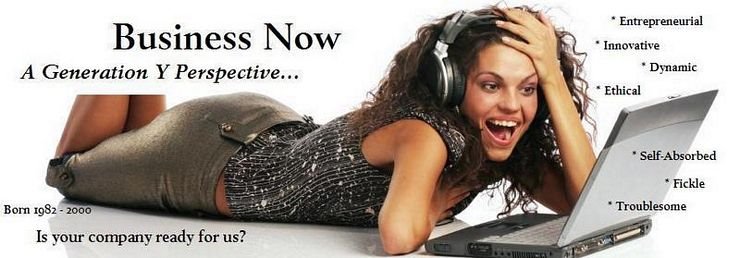
Making the Perfect Gen Y Work Environment - Or Else!

As the first wave of Generation Y makes its way into the workforce, well established corporate cultures are being forced to change - not only the way employees are recruited, but also the way new recruits are treated. Born between 1977 and 1997, Generation Y is the first to have grown up with the internet, be technologically savvy, and have career ambitions that go well beyond earning a high salary. (Business Week, 2005) As company’s are quickly realizing, Generation Y expects to be treated with respect, be constantly challenged with new and innovative tasks, and have the freedom to set their own schedules. As Daun Paris, president of Eastern Consolidated points out, “They want to be able to create their own situations and do it their way.“ (Marsh, 2007) Because of this, Generation Y is largely against high degrees of power distance, and do not feel obligated to stay working for a company that makes them uncomfortable or does not suit their own particular needs.

Despite being deemed self-centered and self-interested by former generations, Generation Y also has a fierce desire to help and protect the larger community; ranging from environmental concerns to human rights activism. (Business Week, 2005) They are consciously seeking out jobs that allow them to work toward these larger causes while at the same time satisfying their own personal growth needs.

So, what does this mean in terms of corporate culture? Using the nine criteria suggested by the GLOBE research program, (Robbins 2005) a successful work environment for Generation Y would be:

Assertive - High: The ability to be confrontational and tough, particularly with higher-ups, is an essential component for Generation Y. They want their opinions to be heard and respected, as well as for their ideas to be taken seriously.

Future Orientation - High: Organizing, planning, and creating “the next new thing” is exactly what motivates Generation Y.

Gender Differentiation - Low: Growing up on the heels of the 1970s feminist movement, this generation does not believe gender should be a factor in the workforce. Both genders should be equally heard and represented.

Uncertainty Avoidance - Low: Social norms and conventions are precisely what Generation Y enjoys breaking and going against. They hold innovation and change above tradition.

Power Distance - Low: Although their may be “leaders,” everyone’s ideas should be taken seriously, and a friendly (rather than respectfully reserved) work environment should be fostered.

Individualism/Collectivism - Both Low and High: Although highly individualized in the sense that they value personal success over company loyalty, they are largely collective in as they want to work toward larger societal causes such as environmentalism.

In-Group Collectivism - High: They value being part of a “team.” This can be exploited through group projects, and a strong company culture. They want to be proud of where they work and what they stand for.

Performance Orientation - Medium: Although it is important to be successful in the end, Generation Y also believes that how they get achieve success is also important. Trying is considered just as valuable as succeeding.

Humane Orientation - High: More so than previous generation, Generation Y is concerned with being fair, tolerant, embraces diversity, and believes equality is crucial to success.

Each of these dimensions should be carefully considered by existing organization trying to retain new recruits from Generation Y. Because they’ve grown up in a culture where job and family stability is a thing of the past, members of Generation Y do not think twice about leaving jobs that they dislike. Catering to their expectations, rather than trying to impose existing company values upon them, is a necessity for company’s wanting to lower turn-over and increase new employee retention.

Overall Generation Y will have it their way, and if they don’t find a company that suits their needs, they will simply create one.

Sources:

Marsh, Amanda. Management Matters. 2/16/2007.
Commercial Property News, Vol 21, Issue 4. P. 16. Reference URL: http://ebsco.waldenu.edu/ehost/detail?vid=11&hid=15&sid=
e515f4da-425b-4bf8-80da-8e159d847566%40sessionmgr2

Welcome to the Gen Y Workplace. May 4, 2005. Business Week Online. Reference URL: http://www.businessweek.com/bwdaily/dnflash/may2005/
nf2005054_4640_db_083.htm?chan=search

Robbins, Stephen P. and Mary Coulter. 2005. Management. Eighth edition. Upper Saddle River, NY. Pearson Education Inc.

Thursday, March 22, 2007

Go Ahead, Have a Cig Kiddo

Why should cigarette manufacturers be permitted complete freedom to target developing countries?

Like any other business, cigarette manufacturers should be able to pursue the objective of profit maximization as long as they fulfill their social obligations and are within the confines of the law (Robbins, 2005). Faced with tightening regulations in developed countries, it makes financial sense for cigarette companies to target their products to foreign consumers whose countries have less restrictive laws. It is the responsibility of national governments, not private enterprises, to concern themselves with the well-being of citizens. If a government decides that smoking has more negative effects on the nation than is tolerable, it will enact laws that will force cigarette companies to conduct business accordingly. Similarly, if consumers do not want to incur the health costs of smoking, they will not buy cigarettes, thereby limiting the profitability of cigarette companies and restricting their expansion. Both governments and consumers have the power to control the operations of cigarette companies, so regardless of which country is targeted, the amount of expansion into that country is always the responsibility of the country itself.

Thursday, March 15, 2007

Efficiency Wages Not So Efficient Anymore

The March 28th online edition of Business Week reports that electronics retailer Circuit City is planning to lower employee wages across the board as a way to reduce costs and boost profits. Faced with fierce competition from long-time rivals such as Best Buy, Circuit City is hoping the wage cuts, along with other structural changes, will allow them to stay ahead of other electronics retailers. (Business Week, 2007)

Previously employees at Circuit City were paid above market, or efficiency, wages. Voluntarily paying higher than average wages has its benefits. First, higher wages attract a better pool of employee candidates. Second, it reduces employee turnover because less people leave for other equitable-position jobs at competing companies. Less turnover leads to a well-trained and experienced sales staff, and eventually more sales. Finally, higher wages gives employees the impression that the company cares about them, which fosters company loyalty and a greater willingness to perform to the best of their abilities while on the job.

In fact, these benefits were taken into account during Circuit City’s decision making process. The retailer realized that the general composition of its sales force would change due to the pay cuts. One major drawback is that the competency of its sales staff will decrease as its best employees leave for higher paying jobs. Also, the time and effort needed to train new employees will undoubtedly have a negative impact on sales in the near future. Because of these changes, “Circuit City is expecting to have consolidated net sales growth of 8% during fiscal 2007, down from the 9% to 10% originally forecast.” (Business Week, 2007) This means that the estimated effect of efficiency wages is between 1-2% of Circuit City’s net sales.

Interestingly, Circuit City does not intend to hire more employees at lesser wages. Instead they will be rehiring the same amount of workers as before. Normally companies that pay above market wages hire fewer employees to keep costs at reasonable levels, leading to less demand but greater supply in the labor force since more people want the higher-paying jobs. Now that Circuit City is lowering its wages to the market equilibrium but keeping the number of employees constant, the demand is not changing, but the supply should decrease because less people will want to work at Circuit City under the new wage structure.

Source:

“Circuit City Cuts Wages to Juice Profits.” Business Week Online. March 28, 2007.
Reference URL: http://www.businessweek.com/investor/content/mar2007/pi20070328_712708.htm?
chan=top+news_top+news+index_investing

Saturday, March 10, 2007

Redressing Old Drugs for Profit

Drug patents are making headlines in the online version of CNN Money this week. Apparently major pharmaceutical companies are facing big losses this year due to the expiration of some of their leading drug patents, decreasing their monopolistic holds on the drugs and making room in the market for increased competition. As the cheaper generic versions of these drugs hit the shelves prices will undoubtedly fall, which means better deals for consumers, but large blows for major pharmaceuticals. In fact, the industry is projected to lose a total of $16 billion in revenue due to the increased competition caused by the loss of these patents. (Smith, 2007)

In an attempt to curb their losses, many companies are tweaking their drugs slightly, such as making time-released formulas, in the hopes of retaining some exclusive patent rights. (Smith, 2007) Now although this type of patent manipulation makes sense in terms of company revenue, what of the larger pharmaceutical goal of helping people live healthier lives? Privatizing pharmaceutical companies and making them for-profit inherently creates a tension between the societal benefits of medicine and the individual company desire to maximize gains. In this case the introduction of generic versions is something that everyone should ideally support. After all, lower prices means more of the drugs will get to more of the people who need them. On the other hand, no one can expect an industry to give up $16 billion without a fight.

So why doesn’t the government step in to right this potentially life-threatening market failure? Because if companies had no monetary (monopolistic patent) incentive to create new drugs, theoretically none would be created, and society would generally be worse off. Patents are designed to expire so that the full benefits to society of new drugs eventually prevail via generic versions and market competition. This allows for companies to profit substantially at the expense of society for a limited amount of time. In essence the patent system is a compromise between creative incentive and social welfare. However, as is evidenced by recent drug tweaking and patent law circumvention, this system may not work as well as intended.

Source:

Smith, Aaron. “Big Pharma teaches old drugs new tricks: Drugmakers hunt for new patents on old blockbusters to try and postpone the inevitable: generic competition.” CNN Money Online. March 21, 2007. Reference URL:
http://money.cnn.com/2007/03/21/news/companies/drug_patents/index.htm?postversion=
2007032115