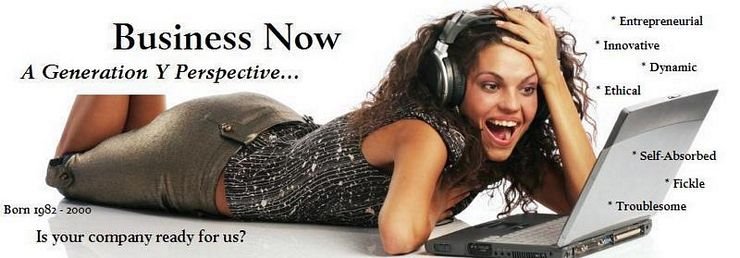
As the first wave of Generation Y makes its way into the workforce, well established corporate cultures are being forced to change - not only the way employees are recruited, but also the way new recruits are treated. Born between 1977 and 1997, Generation Y is the first to have grown up with the internet, be technologically savvy, and have career ambitions that go well beyond earning a high salary. (Business Week, 2005) As company’s are quickly realizing, Generation Y expects to be treated with respect, be constantly challenged with new and innovative tasks, and have the freedom to set their own schedules. As Daun Paris, president of Eastern Consolidated points out, “They want to be able to create their own situations and do it their way.“ (Marsh, 2007) Because of this, Generation Y is largely against high degrees of power distance, and do not feel obligated to stay working for a company that makes them uncomfortable or does not suit their own particular needs.
Despite being deemed self-centered and self-interested by former generations, Generation Y also has a fierce desire to help and protect the larger community; ranging from environmental concerns to human rights activism. (Business Week, 2005) They are consciously seeking out jobs that allow them to work toward these larger causes while at the same time satisfying their own personal growth needs.
So, what does this mean in terms of corporate culture? Using the nine criteria suggested by the GLOBE research program, (Robbins 2005) a successful work environment for Generation Y would be:
Assertive - High: The ability to be confrontational and tough, particularly with higher-ups, is an essential component for Generation Y. They want their opinions to be heard and respected, as well as for their ideas to be taken seriously.
Future Orientation - High: Organizing, planning, and creating “the next new thing” is exactly what motivates Generation Y.
Gender Differentiation - Low: Growing up on the heels of the 1970s feminist movement, this generation does not believe gender should be a factor in the workforce. Both genders should be equally heard and represented.
Uncertainty Avoidance - Low: Social norms and conventions are precisely what Generation Y enjoys breaking and going against. They hold innovation and change above tradition.
Power Distance - Low: Although their may be “leaders,” everyone’s ideas should be taken seriously, and a friendly (rather than respectfully reserved) work environment should be fostered.
Individualism/Collectivism - Both Low and High: Although highly individualized in the sense that they value personal success over company loyalty, they are largely collective in as they want to work toward larger societal causes such as environmentalism.
In-Group Collectivism - High: They value being part of a “team.” This can be exploited through group projects, and a strong company culture. They want to be proud of where they work and what they stand for.
Performance Orientation - Medium: Although it is important to be successful in the end, Generation Y also believes that how they get achieve success is also important. Trying is considered just as valuable as succeeding.
Humane Orientation - High: More so than previous generation, Generation Y is concerned with being fair, tolerant, embraces diversity, and believes equality is crucial to success.
Each of these dimensions should be carefully considered by existing organization trying to retain new recruits from Generation Y. Because they’ve grown up in a culture where job and family stability is a thing of the past, members of Generation Y do not think twice about leaving jobs that they dislike. Catering to their expectations, rather than trying to impose existing company values upon them, is a necessity for company’s wanting to lower turn-over and increase new employee retention.
Overall Generation Y will have it their way, and if they don’t find a company that suits their needs, they will simply create one.
Sources:
Marsh, Amanda. Management Matters. 2/16/2007.
Commercial Property News, Vol 21, Issue 4. P. 16. Reference URL: http://ebsco.waldenu.edu/ehost/detail?vid=11&hid=15&sid=
e515f4da-425b-4bf8-80da-8e159d847566%40sessionmgr2
Welcome to the Gen Y Workplace. May 4, 2005. Business Week Online. Reference URL: http://www.businessweek.com/bwdaily/dnflash/may2005/
nf2005054_4640_db_083.htm?chan=search
Robbins, Stephen P. and Mary Coulter. 2005. Management. Eighth edition. Upper Saddle River, NY. Pearson Education Inc.
Showing posts with label demographics. Show all posts
Showing posts with label demographics. Show all posts
Thursday, April 12, 2007


Thursday, March 1, 2007
Euro-Disney Culture Shock
The differences between American and European, particularly French, cultures and spending habits were two of the largest contributing factors to the initial failure of Euro-Disney. With its grand opening during a 1992 economic recession, Euro-Disney failed to garner expected revenues despite achieving its projected amount of yearly visitors. For example, Americans spent money on Disney supplied lunches while the French brought their own. Americans accepted and appreciated the no-alcohol policy of the theme parks, but the French were appalled at having that freedom restricted. Not taking into account these types of behavioral differences during the planning phase of Euro-Disney proved to be a costly and time-consuming mistake that took roughly two years to correct (Hartley, 2005).
Perhaps the best method to use in terms of understanding and being able to compensate for cultural differences would have been to use a questionnaire prior to making decisions about food, expected revenues other than park admission, and the like. The questionnaire could have been given to potential employees of the park during their interviews before the park opened. This would have tapped into a fairly large pool of potential visitors without much effort. Asking open-ended questions such as "Would you buy souvenirs during your visit? How much would you anticipate spending on them?", "How long do you think you would spend visiting the park?" or "What types of foods and drinks would you like to see offered at the park?" might have helped bring certain problems to light during the final planning stages.
Source:
Hartley, Robert F. 2005. Management Mistakes and Successes. Eighth edition. John Wiley & Sons, Inc.
Perhaps the best method to use in terms of understanding and being able to compensate for cultural differences would have been to use a questionnaire prior to making decisions about food, expected revenues other than park admission, and the like. The questionnaire could have been given to potential employees of the park during their interviews before the park opened. This would have tapped into a fairly large pool of potential visitors without much effort. Asking open-ended questions such as "Would you buy souvenirs during your visit? How much would you anticipate spending on them?", "How long do you think you would spend visiting the park?" or "What types of foods and drinks would you like to see offered at the park?" might have helped bring certain problems to light during the final planning stages.
Source:
Hartley, Robert F. 2005. Management Mistakes and Successes. Eighth edition. John Wiley & Sons, Inc.
Friday, February 16, 2007
Race, Internet, and Necessity
According to the March 15 online edition of Business Week the racial gap between those who have internet access and those who do not is narrowing. Recent research reveals that 71% of non-Hispanic whites, 60% of non-Hispanic blacks, and 56% of Latino adults access the internet. Apparently the major difference in internet usage between the races is the quality of internet access and where they are able to connect. Only 29% of Hispanics have broadband in their homes, while 43% of whites and 31% of African Americans have this feature. For those who do not have internet in their homes at all, public libraries are a main source of access. (Holahan, 2007)
This information is interesting when considering what type of good the internet is. Presently the internet is a natural monopoly. It’s largely excludable because not everyone can readily access the internet without paying for it, and it is not rival in consumption because one person using it does not stop or diminish the ability of others to use it. The only exception to this is accessing it through public libraries for free, in which case the internet could be classified as a common resource. However, since this type of access is used much less than access via private subscriptions, the internet is currently a natural monopoly.
As a natural monopoly, the supply and demand equilibrium is largely guided by price alone; only those who can afford private subscriptions have access to the internet. But is this fair? Should this be considered an example of market failure? Should the government do more to subsidize internet access?
Taking into account how large a role the internet plays in both business and personal affairs, not having access to this resource could be as damaging to society as a whole as not having clean water, food, etc. Paying household bills, searching for employment, even higher education, are all facilitated by the internet. The social benefits of providing equal internet access to all citizens may be higher than current demand dictates, marking this as an example of market failure. By providing free access at public libraries, the government is taking steps to correct this situation, but a gap still exists. One way to bring the social demand and supply to its optimal equilibrium is to provide subsidies to low income families, perhaps as a branch of the welfare system, for private access. This may include funding part of computer purchasing costs as well as internet subscription fees. Already the internet is an integral part of many everyday tasks, and as technological advances continue, access will no longer be considered a luxury, but a necessity.
Source:
Holahan, Catherine. “America’s Digital Divide Narrows.” Business Week Online. March 15, 2007. Reference URL:
http://www.businessweek.com/technology/content/mar2007/tc20070315_573361.htm?chan=
top+news_top+news+index_technology
This information is interesting when considering what type of good the internet is. Presently the internet is a natural monopoly. It’s largely excludable because not everyone can readily access the internet without paying for it, and it is not rival in consumption because one person using it does not stop or diminish the ability of others to use it. The only exception to this is accessing it through public libraries for free, in which case the internet could be classified as a common resource. However, since this type of access is used much less than access via private subscriptions, the internet is currently a natural monopoly.
As a natural monopoly, the supply and demand equilibrium is largely guided by price alone; only those who can afford private subscriptions have access to the internet. But is this fair? Should this be considered an example of market failure? Should the government do more to subsidize internet access?
Taking into account how large a role the internet plays in both business and personal affairs, not having access to this resource could be as damaging to society as a whole as not having clean water, food, etc. Paying household bills, searching for employment, even higher education, are all facilitated by the internet. The social benefits of providing equal internet access to all citizens may be higher than current demand dictates, marking this as an example of market failure. By providing free access at public libraries, the government is taking steps to correct this situation, but a gap still exists. One way to bring the social demand and supply to its optimal equilibrium is to provide subsidies to low income families, perhaps as a branch of the welfare system, for private access. This may include funding part of computer purchasing costs as well as internet subscription fees. Already the internet is an integral part of many everyday tasks, and as technological advances continue, access will no longer be considered a luxury, but a necessity.
Source:
Holahan, Catherine. “America’s Digital Divide Narrows.” Business Week Online. March 15, 2007. Reference URL:
http://www.businessweek.com/technology/content/mar2007/tc20070315_573361.htm?chan=
top+news_top+news+index_technology
Subscribe to:
Posts (Atom)


